
Algeria advances licensing round and gas projects to underpin its energy ambitions
Algeria is pressing a series of energy initiatives, a new upstream licensing round, gas sales at their strongest in months, and progress on long-delayed international projects, that together are lifti...
Algeria is pressing a series of energy initiatives, a new upstream licensing round, gas sales at their strongest in months, and progress on long-delayed international projects, that together are lifting its hydrocarbons-dependent economy and advancing its ambition to serve as a durable gas supplier to Europe. The momentum is real, but it runs against structural constraints that make the ambition harder to secure than the recent gains suggest.
At the centre of the push is the "Algeria Bid Round 2026," launched in April by the upstream regulator Alnaft.
The tender offers seven exploration zones across Ouargla, Illizi, Touggourt and El Bayadh, containing oil and gas prospects that officials estimate hold hundreds of millions of barrels of oil and significant volumes of gas. Bids are due on 26 November, with contracts to be signed with state company Sonatrach by end-January 2027 under production-sharing or participation agreements. It is the second of five rounds Algeria plans through 2028. Hydrocarbons minister Mohamed Arkab has framed the round as strengthening global energy security and reinforcing Algeria's role as a regional energy hub.
The regulator has acknowledged lessons from the first round, held in 2025, which awarded five of six blocks to firms including TotalEnergies, Eni and Sinopec but drew limited competition, with only one block attracting more than one bid.
The licensing effort sits within a far larger investment programme. Sonatrach has committed around $60-billion over 2025-2029, with roughly 80% directed to exploration and production, alongside refining and petrochemicals aimed at increasing domestic value-added and cutting imports.
Brownfield gas recovery is a priority, including a $2.3-billion boosting project at the pivotal Hassi R'Mel hub, and Eni-Sonatrach accords signed in 2025 target an additional 5.5-billion cubic metres a year by 2028 through some $8-billion of joint projects.
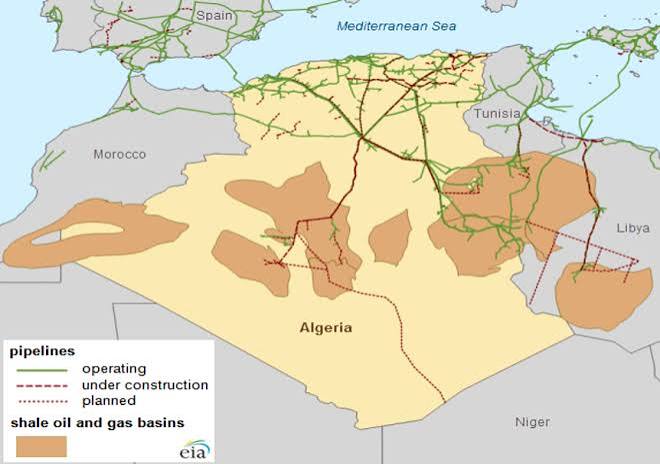
The most consequential prize is unconventional. Algeria holds the world's third-largest shale gas resources, estimated at around 700-trillion cubic feet, and has been in extended talks with US majors ExxonMobil and Chevron, both of which signed memoranda in 2024 to evaluate its shale potential. If those discussions convert into development, they could materially upgrade Algeria's production outlook, drawing on the two companies' deep shale experience. Sonatrach executives have described shale gas as the country's best resource and a strategic priority.
Underpinning the whole strategy is Europe. Since Russia's 2022 invasion of Ukraine curtailed Russian gas flows, Algeria has sought to position itself as a preferred alternative supplier, exporting via the TransMed and Medgaz pipelines and as LNG from its Arzew and Skikda terminals. Long-term contracts with European buyers de-risk the upstream gas investment and have tilted Algeria's capital allocation toward gas over crude. It is this role, gas anchor for a Europe diversifying away from Moscow, that underlies the "middle power" ambition the strategy is designed to serve.
The obstacles, however, are substantial and largely absent from the upbeat framing. Algeria's gas output and exports both fell about 7% in 2024, to 98.3-billion and 48.5-billion cubic metres respectively, squeezed by natural decline at mature fields and by surging domestic demand, which now absorbs roughly 55% of output and is growing at over 5% a year, with gas supplying about 99% of Algerian electricity. Wood Mackenzie forecasts that marketed production will peak around 2027 before plateauing.
The country has few untapped conventional fields left, making the delayed south-western projects and the unproven shale programme central to any sustained growth. Reform is slow: the absence of dozens of implementing decrees under the 2019 hydrocarbons law has extended the ExxonMobil and Chevron shale negotiations by an estimated 12 to 18 months, and the 51/49 foreign-ownership rule continues to complicate financing.
The result is a strategy of genuine momentum shadowed by a hard arithmetic. Algeria can raise its exportable gas only by simultaneously arresting field decline, curbing a domestic demand it is politically unwilling to price higher for households, and unlocking a shale resource that remains technically and commercially unproven at scale.
The licensing round and the majors' interest are real signs of progress, and Europe's need gives Algeria a strategic opening it is right to pursue. Whether that opening translates into the durable supply role Algiers envisages depends on execution against constraints, decline, demand and reform, that the current wave of announcements does not resolve.